
How to Make Walking the Dog Part of Your Daily Routine (the Atomic Habits Way)
Struggling to walk the dog every day? Here’s how I used the four rules from Atomic Habits to turn our dog walk into a habit that sticks, plus a fill-in plan you can print and put on the fridge.
Why I stopped waiting to feel like it
For a long time, my dog walks depended on how my day went. A quiet day meant a walk. A day full of work, school runs and dinner meant the walk was the first thing to go.
What changed it for me was a book about habits. Atomic Habits by James Clear has nothing to do with dogs, but one idea from it stuck. Clear argues that your results come from your systems far more than from your goals. "Walk Bindi more" was a goal. I had no system.
So I built one. Below are the four rules from the book and how I use each one to make the daily walk something that just happens in our house.
Start with who you want to be
One of the central ideas in Atomic Habits is identity-based habits. Instead of chasing an outcome, you decide what kind of person you are, then prove it with small actions. Clear describes each action as a vote for that identity.
For dog owners this is a helpful switch. "I should walk the dog for 30 minutes a day" is a target you can fail. "I'm someone who walks my dog every day" is something you can prove with a five-minute loop around the block on a rough day.
Say it to yourself as you pick up the lead. It feels a bit silly at first. It works anyway.
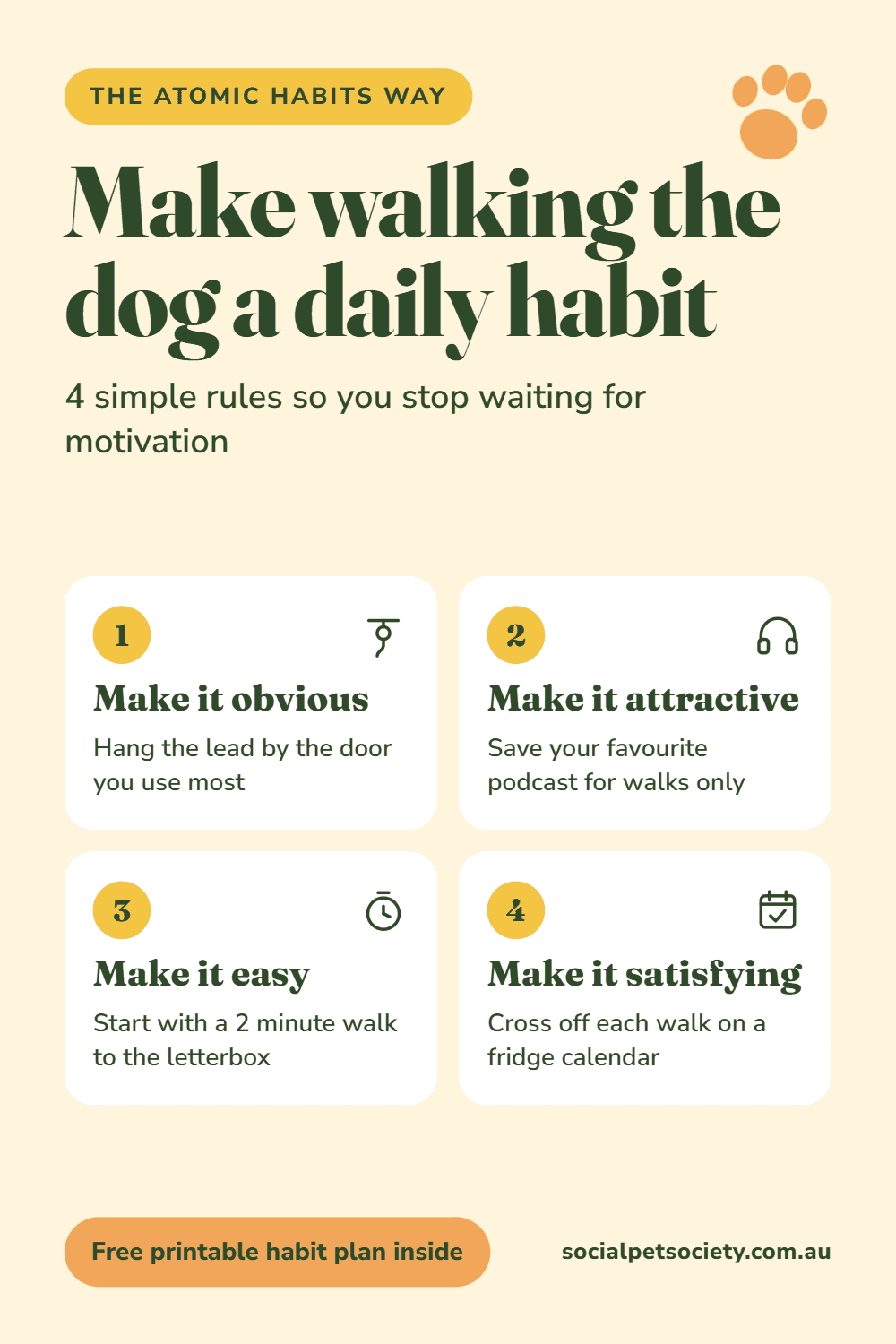
Rule 1: Make it obvious
Every habit starts with a cue that tells your brain it's time to act. According to Clear, the two most common cues are a time and a place. A walk with neither is easy to forget.
Use habit stacking. Clear's formula is "After [current habit], I will [new habit]." Pick something you already do every day without thinking:
- After I get home from school pick-up, I will clip on the lead.
- After I finish my morning coffee, I will walk the dogs to the end of the street.
- After I close the laptop for the day, I will put on my walking shoes.
My own stack is kindy pick-up. I walk to collect my 4-year-old and the dog comes with me, so the walk, my exercise and the pick-up all happen in one trip.
Leave the cue in plain sight. Hang the lead, poo bags and a water bottle on a hook by the door you use most. If you have to dig through a drawer for the lead, that's one more excuse to skip it.
Rule 2: Make it attractive
We're far more likely to do something we look forward to. Clear suggests temptation bundling, which means pairing something you need to do with something you enjoy.
A few ways to bundle a walk:
- Save your favourite podcast or audiobook for walks only.
- Call a friend or family member while you walk.
- Finish at a dog-friendly café. You can find one near you in the Social Pet Society directory.
Clear also points out that we tend to copy the habits of the people around us. If dog walking is normal in your circle, it gets easier to keep up. Arrange to meet another dog owner a couple of mornings a week. In Townsville, Pallarenda's off-leash dog beach or Mindham Park in Mysterton make good meeting spots, and you'll find more on our Townsville off-leash parks page.
Rule 3: Make it easy
This is the rule that made the biggest difference for us. Clear's Two-Minute Rule says a new habit should take less than two minutes to start. The aim is to make starting so easy you can't argue with it.
For dog walking, the two-minute version is clipping on the lead and walking to the letterbox. Most days, once you're out the gate, you'll keep going. On the days you don't, you've still kept the habit alive.
Other ways to cut the effort:
- Keep one pair of shoes just for walks, right by the door.
- Plan a 15-minute loop from home so you never have to decide where to go.
- Walk at the coolest part of the day. In North Queensland that usually means early morning or after sunset. A walk in the midday heat is one you'll talk yourself out of.
A dog that pulls makes every walk feel like hard work. Bindi still pulls, so we've been working on it with basic obedience training and a big "YES!" every time she walks nicely beside me. A calmer walk is a walk you're happy to repeat.
Rule 4: Make it satisfying
Clear calls this the cardinal rule of behaviour change. We repeat what feels rewarding straight away and avoid what doesn't. The problem with exercise is that the payoff is slow, and one walk won't make you feel any fitter.
So give yourself a reward you can see today. A habit tracker is the easiest one. Put a calendar on the fridge and mark a big cross on every day you walk. After a week or two, you won't want to break the run.
Your dog hands out rewards too, if you notice them. Watch how they flop down for the afternoon after a good sniff around the block. In our house, that means a calmer evening for everyone.
What should I do when I miss a day?
You will miss days. Storms roll in, kids get sick, work runs late. Clear's rule for this is to "never miss twice". One missed walk is a blip. Two in a row is how the old habit of skipping creeps back in.
Keep a backup plan for days a proper walk can't happen:
- A five-minute sniff around the block. Sniffing gives your dog's brain a real workout.
- A short training session in the yard or hallway.
- A puzzle feeder or a game of find the treats.
On hot days, test the footpath before you head out. Hold the back of your hand on the ground for five seconds. If it's too hot for your hand, it's too hot for paws. Stick to grass and shade, carry water and keep it short.
How much walking does my dog need, and does it count for me?
Every dog needs time out of the house and yard each day, but how much depends on their age, breed and health. As a starting point, Guide Dogs Australia has encouraged owners to aim for two 30-minute walks a day, one in the morning and one in the evening. Puppies, older dogs and flat-faced breeds may need shorter, gentler outings, so check with your vet.
The walk counts for you as well. Australia's physical activity guidelines recommend adults aged 18 to 64 get 150 to 300 minutes of moderate activity each week. Two 20-minute dog walks a day adds up to 280 minutes a week.
Researchers at the University of Sydney estimated that if dog owners who don't walk their dogs started doing 20 minutes a day, 12 to 17 per cent more Australian adults would be active enough. That's a lot of health sitting at the end of a lead.
Quick Guide: How to Make Walking the Dog Part of Your Daily Routine (the Atomic Habits Way)
Struggling to walk the dog every day? Here’s how I used the four rules from Atomic Habits to turn our dog walk into a habit that sticks, plus a fill-in plan you can print and put on the fridge.
- Time
- 2 minutes to start
- Difficulty
- Easy
Checklist
- Hang the lead, poo bags and water by the door
- Pick your habit stack: After I ___, I will clip on the lead
- Choose a 15 minute loop from home
- Save a podcast or audiobook for walks only
- Walk at the coolest time of day
- Test the footpath with the back of your hand for 5 seconds
- Put a calendar on the fridge and cross off each walk
- Plan a backup for wet or very hot days
- Never miss twice
Frequently asked questions
How long does it take to make dog walking a habit?
There's no magic number of days. Clear argues that how many times you repeat a habit matters more than how long you've been doing it. Show up every day, even for a short walk, and it will start to feel automatic.
What's the best time of day to walk my dog?
The best time is the one you can stick to. In hot weather, choose early morning or evening when the ground is cooler.
What if I don't have time for a long walk?
Do the two-minute version. A short walk keeps the habit going, and you can add a longer outing on the weekend.
Is a big backyard enough exercise for my dog?
A yard doesn't replace a walk. New smells, sights and people give your dog mental exercise that the backyard can't.
Do I need to read Atomic Habits to use these tips?
No. This post covers the main ideas, but the book has plenty more examples if you'd like to go deeper.
This article is for general information only and isn’t a substitute for professional advice. The sources we used are listed below.
References
- Clear, J. (2018) Atomic Habits: An Easy and Proven Way to Build Good Habits and Break Bad Ones. New York: Penguin Random House.
- Department of Health and Aged Care (2021) Physical Activity and Sedentary Behaviour Guidelines: Adults (18 to 64 years) fact sheet. Canberra: Australian Government. Available at: health.gov.au.
- McGreevy, P. and Bauman, A. (2018) 'Are you walking your dog enough?', The Conversation. Available at: theconversation.com.
- Townsville City Council (n.d.) Off-leash areas. Available at: townsville.qld.gov.au.
Related articles

Health and Wellbeing
Is Having a Pet Good for Kids? What the Research Says
Is having a pet good for kids? From responsibility and empathy to comfort for only children, here’s what research says about kids and pets, the best age to get one, and how to keep babies and young children safe around animals.
· Talitha Mulder
Health and Wellbeing
How to Build a Stronger Bond With Your Dog (What the Research Says)
Want a closer bond with your dog? Learn what science says about the dog and human bond, the signs your dog is attached to you, how long bonding takes, and four simple ways to strengthen your connection through touch, play, routine and a calm home.
· Talitha Mulder
Health and Wellbeing
Is My Cat Happy? Use This Checklist to Tell if Your Cat is Content
Not sure if your cat is happy? Use this simple checklist to read the signs of a content cat, spot the warning signs of stress or illness, and learn easy ways to set up your home and routine so your cat feels safe, busy and loved.
· Talitha Mulder