
Loose Lead Walking: Week 2 of Bindi's Training Journey
In week 2 of Bindi's obedience journey we put her praise word, "YES!", to work on loose lead walking, her biggest challenge. This post covers what scientists say about treats, timing, collars and harnesses, and Border Collies.
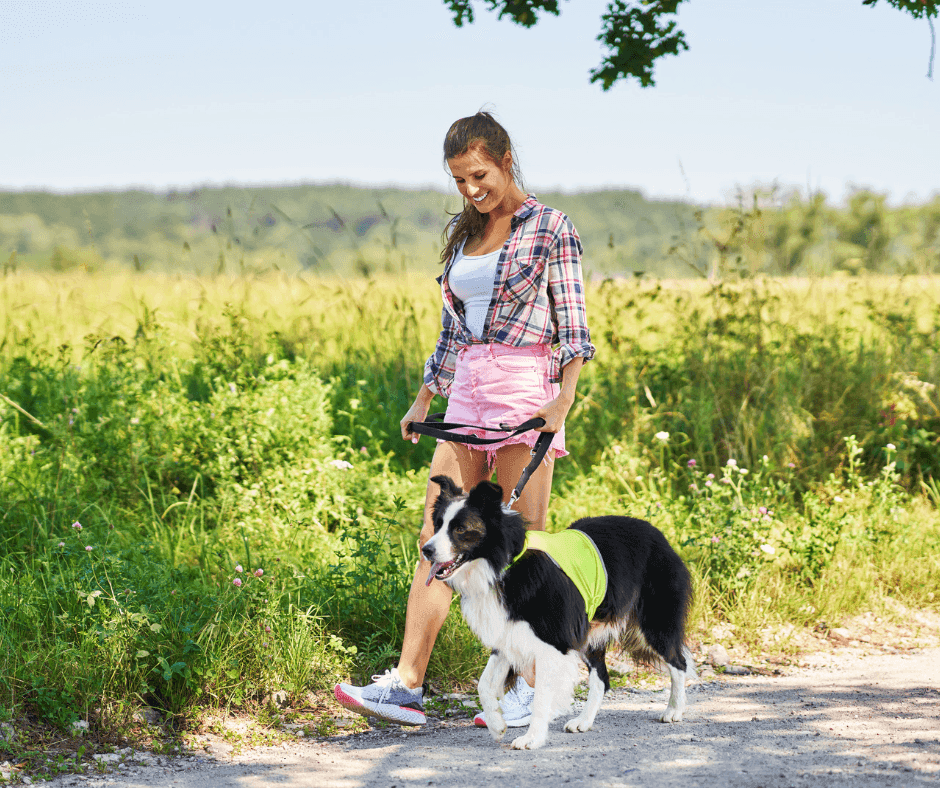
Last week, in How to Teach Your Dog a Praise Word, Bindi learned that "YES!" means a treat is coming. This week we use that word for the skill I have wanted most since she was an 8 week old puppy. I want a dog who walks beside me on a loose lead.
Bindi is obedient and loyal at home. On the lead, she pulls. She is not being naughty or trying to be the boss. She has simply learned that pulling gets her where she wants to go.
Pulling is very common. A 2022 review of the research in the Veterinary Record reports that up to 82% of pet dogs may pull on the lead. The review also explains that pulling can make walks shorter and less fun, and dogs can miss out on sniffing time. So if your dog pulls too, you are in very good company.
Why do Border Collies pull on the lead?
Border Collies pull for the same reason most dogs do. Pulling works. Every time a dog pulls and the walk keeps moving, the dog gets what it wants. That is a reward, even if we never meant to give one. The 2022 review explains that by the time a dog is grown up, it may have a long history of pulling paying off.
Border Collies do bring some extra things to the walk.
- They learn fast. A 2019 study of more than 14,000 dogs from 101 breeds found that trainability differs a lot between breeds, and much of that difference is in the genes. The researchers used Border Collies as their example of a breed bred to follow human signals. A 2011 study of 5,733 dogs from 98 breeds also found herding dogs scored as more trainable than hounds, working dogs and toy dogs.
- Fast learners learn the wrong lesson fast too. A quick learner picks up whatever actually gets rewarded, not what you meant to reward. You will see this with Bindi further down.
- They notice movement and have lots of energy. The 2019 breed study found that chasing and energy levels also differ between breeds and are strongly linked to genes. A bird, a bike or another dog can pull a Border Collie's attention away in a second.
One important note. These studies looked at breed averages. The researchers point out that they do not tell you exactly how your own dog will act. Bindi is her own dog, and so is yours.
Does pulling on a collar hurt my dog's neck?
It can. Researchers at Nottingham Trent University tested 7 collars and a slip lead on a model of a dog's neck. They tried a firm pull (40 newtons), a strong pull (70 newtons) and a jerk (about 141 newtons). The collars pressed on the neck with between 83 and 832 kilopascals of pressure. Every collar, even the padded and wide ones, went over pressure levels known to damage tissue in people. In short, any collar can cause harm when a dog pulls hard enough.
So is a harness the answer? Not on its own. A University of Queensland study tested 52 shelter dogs on both a neck collar and a back clip harness. When the dogs pulled towards a food treat, they pulled harder on the harness. They also spent about 67% of the time pulling on the harness, compared with about 35% on the collar. There was no rise in signs of stress either way.
Here is what I take from this. A harness protects the neck, which matters. It does not teach your dog to stop pulling, and food lovers like Bindi may pull even harder in one. The training is what fixes the pulling.
Avoid choke chains and prong collars. The 2022 review warns that punishment based gear and methods can cause pain, stress, fear and even aggression.
Should I use treats or praise to train loose lead walking?
Use treats. Praise on its own is not enough for most dogs. In a 2012 study, dogs worked harder and faster for a small piece of food than for a short pat and praise. For most dogs, brief praise worked barely better than getting nothing at all.
That does not mean praise is useless. A 2023 follow up study found praise and patting can work as a reward, especially when given now and then. But food was still stronger for most dogs. Bindi gets both: "YES!", then a treat, then a happy word.
Why the praise word matters on a walk. On a walk, Bindi is moving. By the time I dig a treat out of my pocket, she may have stepped ahead again. "YES!" marks the exact moment she got it right. Researchers think a marker helps by telling the dog exactly which action earned the reward.
Do you need a clicker? No. A University of Trieste study of 51 dogs found that dogs learned a new skill just as well with a spoken word, a clicker, or food alone. A word is free, and you cannot leave it at home.
Treat tips that suit a busy walk:
- Use tiny, soft treats your dog can swallow in one go. Pea sized is plenty.
- Take more than you think. Early on you may hand out 20 to 30 in 5 minutes.
- Count treats as part of your dog's daily food so they do not gain weight.
This is the plan we are following with Bindi. Each step is built on the research above. Before you start, grab a well fitted harness, a normal lead about 1.5 to 2 metres long (not retractable), and a pocket full of tiny treats.
Step 1: Check your dog turns to you when you say "YES!".
Say "YES!" and give a treat straight away, 5 times in a row at home. If your dog's head snaps towards you when you hear it, you are ready. If not, go back to last week's praise word steps and practise for a few more days.
Step 2: Pick a side and hold treats in that hand.
Pick the side you want your dog to walk on, and keep treats in the hand on that side. Use the same side every time so your dog knows where the treats show up. Start somewhere boring, like the backyard or hallway, where there is not much to look at.
Step 3: Say "YES!" the moment the lead is loose and your dog is at your leg.
Take one step. If your dog is beside your leg and the lead is loose, say "YES!" right away. Saying it while you are both moving tells your dog the reward is for walking together. At first, mark every 1 or 2 steps.
Step 4: Give the treat right beside your leg.
Give the treat right next to your leg, at your dog's nose height. Your dog should not have to turn around or jump up to get it. Where the treat lands is where your dog will want to be.
Step 5: Stop still whenever the lead goes tight. Move again once it is loose.
When the lead goes tight, stand still like a tree. Do not jerk the lead or tell your dog off. Wait until the lead goes loose, then say "YES!", treat at your leg and walk on. Your dog learns that pulling stops the walk and a loose lead makes it go.
Step 6: Reward walking beside you, not coming back to you
If your dog pulls ahead and then comes back for a treat, do not treat the return. Take 2 or 3 steps together first. If your dog stays beside you with a loose lead, then say "YES!" and treat. Once it is going well, mix up the gaps: treat after 3 steps, then 7, then 4, then 10.
Step 7: Stop after 5 minutes while your dog is still keen
Finish after about 5 minutes, while your dog still wants more. In a study of 18 Beagles, dogs trained once a week learned a task in fewer sessions than dogs trained 5 times a week. A few short sessions a week is enough to make progress.
Step 8: Move to busier places only when your dog is ready.
Once your dog walks nicely in the backyard, try the front yard. Then a quiet street, then a busier one. If your dog falls apart, go back one step and reward more often. As your dog improves, slowly stretch out the treats to every 3, 5, then 10 steps.
Walks still need to be fun. A walk that is all training and no sniffing is no fun for either of you. The 2022 review notes that pulling can cut down sniffing and social time on a walk. So give your dog sniff breaks. A word like "go sniff" can tell them it is their time to explore, then you go back to loose lead walking.
Why does my dog pull ahead, then come back for a treat?
This is what happened with Bindi. Some days she was not walking nicely at all. She would pull out to the end of the lead, then turn and trot back to my side, looking up for her treat. She had worked out a game. Pull ahead, come back, get paid.
It makes sense when you think about how dogs learn. A dog links the reward to whatever it did just before the reward came. Bindi got her treat right after she came back to me. So coming back got rewarded. And the only way to come back is to leave first. Without meaning to, I was teaching her a loop: pull, return, treat, repeat.
A quick learner like a Border Collie can pick up a loop like this in just a few walks. The fix is to reward walking beside you, not arriving beside you.
How to fix the pull and come back loop:
- Do not treat the return. When your dog comes back to your side, say nothing yet. Take 2 or 3 steps forward together. If your dog stays beside you with a loose lead for those steps, then say "YES!" and treat.
- Mark while moving. Say "YES!" while you are both walking, not after you stop. That way the reward is for walking together.
- Treat at your leg. Give the treat right beside your leg, at your dog's nose height. Your dog should not have to turn around or look up at your face to get it.
- Make it easier, not harder. If your dog keeps looping, you are asking for too much. Go back to the backyard and reward every single step for a few minutes.
- Mix up the gaps. Once your dog is doing well, treat after 3 steps, then 7, then 4, then 10. That way your dog cannot time the loop to the treat.
If your dog does the same thing, it is not being clever at your expense. It is learning exactly what the treats taught. That is actually good news, because it means the treats work. We just need to point them at the right moment.
Why is it so hard to keep going with lead training?
Here is the honest part. You start lead training not knowing if it will work. That makes it really hard to keep going.
If someone promised me that 20 hours of practice would give me a dog who walks perfectly, I would find those 20 hours. I would put a heap of time into it. But nobody can promise that. So on a busy day, with kids to pick up, it is easy to think "what is the point?" and just clip the lead on and go. Then she pulls, and the old habit gets a little stronger.
If you feel like this, you are not lazy. The researchers agree this skill is hard. The 2022 review notes that loose lead training may take more time and skill than owners expect.
The good news: short and spread out works. Two studies from the University of Copenhagen looked at how often dogs should be trained.
- In the first, 18 Beagles learned a new task. Dogs trained once a week needed fewer sessions to learn it than dogs trained 5 times a week.
- In the second, dogs trained 1 to 2 times a week learned better than dogs trained every day. Dogs given 1 session at a time also learned better than dogs given 3 sessions in a row. Once the dogs had learned the task, they remembered it for at least 4 weeks.
These were lab dogs learning one simple task, not pet dogs on a busy footpath. So the results are a guide, not a rule. But they do tell me something freeing. Training does not have to be a huge, daily grind to count.
What this means in real life:
- A few focused 5 minute sessions a week, with no guilt about the days in between.
- On busy days, a harness and a calm walk, with no training expected.
- Small wins counted. Ten loose lead steps down the driveway is progress.
- A quick note on your phone after each session, so you can look back and see change you would otherwise miss.
If you also struggle with just getting out the door, my post on making walking the dog a daily habit might help.
Why is my small dog so much easier to walk?
I also have a little chug (a Chihuahua and Pug cross). He is easy to walk. But that is not because he was trained better. It is because he has never had the power to really pull. A small tug on the lead is easy to ignore, so poor walking just never felt like a problem.
Research suggests this is common. A study from the University of Veterinary Medicine Vienna surveyed 1,276 dog owners and compared dogs under 20 kg with dogs 20 kg and over. Owners of smaller dogs said they were less consistent with their dogs, and did less training and play with them. In smaller dogs, more consistent owners and more training and play were linked to better obedience.
I think that is exactly what happens in our house. Bindi is strong enough that her pulling is hard to ignore, so it gets my attention.
Small dogs still deserve good lead manners, for two reasons.
- Their necks matter too. The collar study found pressure that could cause harm even at the lowest pulling force they tested.
- Flat faced breeds are at extra risk. Dogs with short, flat faces, like Pugs and many Pug crosses, can already have breathing and eye problems. The 2022 review explains that pulling on a collar puts them at higher risk, so a harness is often recommended.
The same steps in this post work for small dogs. Just bend down a bit further to give the treat at nose height.
Quick Guide: Loose Lead Walking: Week 2 of Bindi's Training Journey
In week 2 of Bindi's obedience journey we put her praise word, "YES!", to work on loose lead walking, her biggest challenge. This post covers what scientists say about treats, timing, collars and harnesses, and Border Collies.
- Time
- 5 minutes per session a few sessions a week
- Difficulty
- Medium
Checklist
- Praise word your dog already knows ("YES!")
- Tiny, soft treats, about 30 per session
- Treat pouch or easy to reach pocket
- Well fitted harness
- Normal lead, 1.5 to 2 metres (not retractable)
- A quiet place to start, like a backyard or hallway
- A note on your phone to track progress
Frequently asked questions
How long does it take to teach a dog to walk on a loose lead?
There is no set time. It depends on your dog's age, how long it has been pulling, and how often you practise. A 2022 review of the research notes that loose lead walking may take more time and skill than owners expect. Count progress in small steps, not weeks.
Is a harness better than a collar for a dog that pulls?
A harness is kinder to the neck. In a model neck study, every collar tested put out pressure above levels that damage human tissue. But a harness will not stop pulling. In a University of Queensland study, dogs pulled harder towards food in a back clip harness than in a collar.
Are treats or praise better for lead training?
Treats. In a 2012 study, dogs worked harder for a small piece of food than for a short pat and praise. Use praise as well, but do not rely on it alone.
Do I need a clicker to train loose lead walking?
No. In a study of 51 dogs, dogs learned just as well with a spoken word as with a clicker. A short, happy word like "YES!" works well.
Will my puppy grow out of pulling?
Do not count on it. Pulling is rewarded every time the walk keeps going, so the habit can grow stronger with age, as the 2022 review explains. It is easier to teach good lead manners early.
How often should I train my dog?
Short and spread out is fine. In lab studies from the University of Copenhagen, dogs trained once a week learned a task in fewer sessions than dogs trained 5 times a week.
Why does my dog pull more when it is excited?
Excited dogs find it harder to focus, and Border Collies notice movement fast. Start training somewhere quiet and add distractions slowly. For hot days, check my post on the best time of day to walk your dog in Queensland.
This article is for general information only and isn’t a substitute for professional advice. The sources we used are listed below.
References
- Arhant, C., Bubna-Littitz, H., Bartels, A., Futschik, A. and Troxler, J. (2010) 'Behaviour of smaller and larger dogs: effects of training methods, inconsistency of owner behaviour and level of engagement in activities with the dog', Applied Animal Behaviour Science, 123(3-4), pp. 131-142. Available at: https://doi.org/10.1016/j.applanim.2010.01.003
- Carter, A.J., McNally, D. and Roshier, A.L. (2020) 'Canine collars: an investigation of collar type and the forces applied to a simulated neck model', Veterinary Record, 187(7), e52. Available at: https://doi.org/10.1136/vr.105681
- Chiandetti, C., Avella, S., Fongaro, E. and Cerri, F. (2016) 'Can clicker training facilitate conditioning in dogs?', Applied Animal Behaviour Science, 184, pp. 109-116. Available at: https://arts.units.it/handle/11368/2899105
- Demant, H., Ladewig, J., Balsby, T.J.S. and Dabelsteen, T. (2011) 'The effect of frequency and duration of training sessions on acquisition and long-term memory in dogs', Applied Animal Behaviour Science.
- Feng, L.C., Howell, T.J. and Bennett, P.C. (2016) 'How clicker training works: comparing reinforcing, marking, and bridging hypotheses', Applied Animal Behaviour Science, 181, pp. 34-40. Available at: https://doi.org/10.1016/j.applanim.2016.05.012
- Feuerbacher, E.N. and Wynne, C.D.L. (2012) 'Relative efficacy of human social interaction and food as reinforcers for domestic dogs and hand-reared wolves', Journal of the Experimental Analysis of Behavior, 98(1), pp. 105-129. Available at: https://pmc.ncbi.nlm.nih.gov/articles/PMC3408722
- Feuerbacher, E.N., Togher, C. and Friedel, J.E. (2023) 'Social interaction can function as a reinforcer for dogs: effects of stimulus duration and session parameters', Journal of the Experimental Analysis of Behavior. Available at: https://doi.org/10.1002/jeab.842
- MacLean, E.L., Snyder-Mackler, N., vonHoldt, B.M. and Serpell, J.A. (2019) 'Highly heritable and functionally relevant breed differences in dog behaviour', Proceedings of the Royal Society B, 286(1912), 20190716. Available at: https://doi.org/10.1098/rspb.2019.0716
- Meyer, I. and Ladewig, J. (2008) 'The relationship between number of training sessions per week and learning in dogs', Applied Animal Behaviour Science, 111(3-4), pp. 311-320.
- Shih, H.Y., Phillips, C.J.C., Mills, D.S., Yang, Y., Georgiou, F. and Paterson, M.B.A. (2021) 'Dog pulling on the leash: effects of restraint by a neck collar vs. a chest harness', Frontiers in Veterinary Science, 8, 735680. Available at: https://doi.org/10.3389/fvets.2021.735680
- Townsend, L., Dixon, L. and Buckley, L. (2022) 'Lead pulling as a welfare concern in pet dogs: what can veterinary professionals learn from current research?', Veterinary Record, 191(10), e1627. Available at: https://doi.org/10.1002/vetr.1627
- Turcsán, B., Kubinyi, E. and Miklósi, Á. (2011) 'Trainability and boldness traits differ between dog breed clusters based on conventional breed categories and genetic relatedness', Applied Animal Behaviour Science, 132(1-2), pp. 61-70. Available at: https://doi.org/10.1016/j.applanim.2011.03.006
Related articles

How-To Guides
Taking your dog on the Magnetic Island ferry
Yes, your dog can come to Magnetic Island. Here are the pet rules for the SeaLink passenger ferry and the Magnetic Island Ferries car ferry, how to get your dog used to a muzzle, and where dogs can and can’t go once you land.
· Talitha Mulder
Health and Wellbeing
How to Make Walking the Dog Part of Your Daily Routine (the Atomic Habits Way)
Struggling to walk the dog every day? Here’s how I used the four rules from Atomic Habits to turn our dog walk into a habit that sticks, plus a fill-in plan you can print and put on the fridge.
· Talitha Mulder