
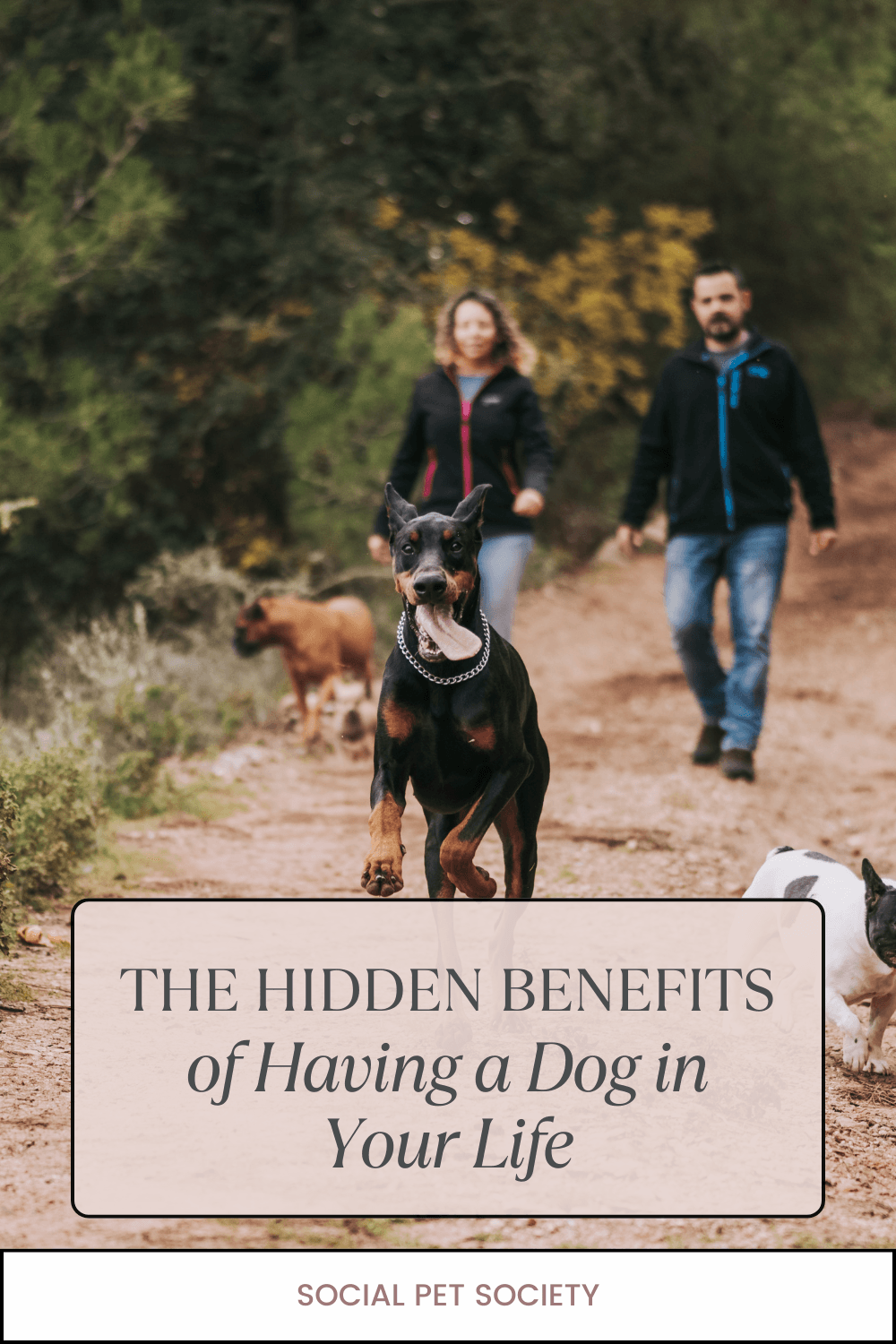
The Hidden Benefits of Having a Dog in Your Life
Talk to any self proclaimed dog lover and they’ll tell you, dogs aren’t just pets. Personally, I think they are life’s subtle teachers, showing us what really matters in life. And below, I’ve listed the 12 hidden benefits of a dog that you may be overlooking. Table of Contents Disclosure: This…
Talk to any self proclaimed dog lover and they’ll tell you, dogs aren’t just pets.
Personally, I think they are life’s subtle teachers, showing us what really matters in life.
And below, I’ve listed the 12 hidden benefits of a dog that you may be overlooking.
Table of Contents
Disclosure: This article includes affiliate links. If you click on these links and make a purchase, I receive a small commission. This comes at no extra cost to you but greatly supports the maintenance of this site. Learn more here.
The Hidden Benefits of a Pet Dog
Conversation Starter
his research suggests companion animals can be a catalyst for several dimensions of human social relationships in neighborhood settings, ranging from incidental social interaction and getting to know people, through to formation of new friendships. For many pet owners, their pets also facilitated relationships from which they derived tangible forms of social support, both of a practical and emotionally supportive nature. Given growing evidence for social isolation as a risk factor for mental health, and, conversely, friendships and social support as protective factors for individual and community well-being, pets may be an important factor in developing healthy neighborhoods [1].
Teaching Kids to Care
The purpose of this study is to produce knowledge about the impact of pets on preschool children’s desire to learn and their development. The research question asked is: What do children learn from and with pets: The example of dog and cat? Socio-cultural theories and developmental pedagogy are used in order to study children’s learning in the preschool. The socio-cultural theories are based on a model describing interactions between people presented by Vygotskij (1978) and further developed by Säljö (2011). This study employed a qualitative exploratory research method with the aim of gaining knowledge concerning a group of 24 children, aged 4-5 years. Individual interviews were used as the method of data collection. The results are presented as two main categories: 1) The pet supports the child in their learning and development process 2) The child is the teacher of the pet. Each main category comprised two subcategories: 1a) Developing empathy and emotions, 1b) Being good at school-related tasks, 2a) Teaching the pet playful exercises, 2b) Teaching the pet to obey. The results show that pets provide children with positive experiences and a sense of feeling good. The children said that they could talk to all the animals and that the animals are listening. When a child is doing activities with an animal or tries to teach an animal some exercises, the child receives a response from the animal. This leads on to new experiences and an increased knowledge regarding social behavior. Using pets for educational purposes in the home, preschool and school, might stimulate an interest in animal care and a commitment to the world´s wildlife and fauna in general. [2]
Unwavering Loyalty
A dog isn’t just around for the good times—they’re with you, through thick and thin, offering loyalty without hesitation, every single day of their life.
The Best Listener
Your dog will listen to every word, every frustration, every joy, without judgment. A rare, precious gift in a world that demands so much from us.
Free Fitness Coach
You’ll have to get moving. Dogs need walks. They need playtime. And as much as they need you, you need them to get outside, breathe fresh air, and stay active.
Pre Dishwasher
Need your plate cleaned? Your dog is always on duty—just be sure to wash their dishes after.
Daily Laughter
Dogs bring humour into our lives in the simplest ways. Five laughs a day add up to nearly 1,800 moments of joy each year. All for free.
Mood Booster
Feeling down? A dog will cheer you up. Feeling frustrated? They’ll calm you down. When you’re lonely, they’ll keep you company, always reminding you that you’re never really alone.
Security Alarm
That bark? It’s not just noise. It’s their way of protecting you, alerting you to dangers you might not see.
Sense of Purpose
n
True Friendship
Katcher (1981) says that 99% of people talk to their animals and believe they understand to a degree. He says that in most cases, pet owners use “Motherese” or baby talk (a simplified form of language used to help children understand and learn to speak). Katcher believes that the bias against sentimentality in science has blinded researchers’ perceptions of the significant, distinctive role that pets play in people’s lives and that we must recognize this relationship as one that augments relationships with other humans. Perin (1981) goes so far as to assert that dogs are a symbol of our own “memory of that magical once-in-a-lifetime bond” we shared with our mothers. She says people have dogs for the “satisfaction of giving and receiving complete and total love and devotion,” which is why dogs are idealized in modern society. [4]
Therapy
Lorem ipsum dolor sit amet, consectetur adipiscing elit. Ut elit tellus, luctus nec ullamcorper mattis, pulvinar dapibus leo.
Judge of Character
Dogs have indeed special skills to understand and interact with humans due to the evolutionary history and domestication of the species and due to complex competences acquired by individual and social learning. We see accumulating evidence of their understanding of human emotions, gestures, and actions and of how much they are thus part of human culture and our social game. Bonds between dogs and humans are selective, intense, and vary in quality. Affiliation plays a motivational role in dog behavior and shapes the dogs’ attitudes as well as their interaction with humans. All of this, however, has to be seen in the light of a comprehensive characterization of the human-dog relationship, which is a socially constructed practice with clear power relations. We have argued that the human-dog relationship is a dominance relationship where humans are usually in command of power. If caregivers are unaware about how much their dogs pay attention to subtle communicative cues and how much they understand about as well as attend to their caregivers’ emotions, gestures, and actions, a range of conflicts can arise. Instead we should invest into building relationships of trust with dogs that live up to ideas of companionship.
Irvine (2004) arrived at the conclusion that “relationships between humans and animals have depended on how a given society defines animals and what it means to associate with them”. She argues that “what we currently know about animals demands wrestling with the moral implications of keeping them as pets” (Irvine, 2004, 5). We have been following this critical view of pet keeping in general and dog keeping in specific, because it could serve as a helpful heuristic to map out problems that are often overlooked, specifically problems that point beyond welfare towards other normative concepts. Sixteen years after Irvine’s paper we face a substantial amount of new research results on dog social cognition which we have summarized in this paper and which we need to take into account when debating the human-dog relationship today.
From what we have discussed we gain a better understanding of a main characteristic of the human-dog relationship that lies in its dichotomy between special attachment as well as special understanding on the one hand and the instrumentalization of dogs on the other hand. Against this backdrop, a meaningful social interaction between dogs and caregivers remains a fragile construct. In order to treat dogs in the way that morality requires of us, it is paramount that we bear in mind the spectrum of positive duties that this relationship engenders, including the duty to live up to the trust that dogs place in us.
[3]
Conclusion
A dog is a commitment—a lifelong one. But if you have the heart, the time, and the patience, they will be the best friend you never knew you needed. Worth every moment. Worth every lesson. Worth every wag of the tail.
Sources:
[1] https://journals.plos.org/plosone/article?id=10.1371/journal.pone.0122085
[2] https://www.ceeol.com/search/article-detail?id=973056
[3] https://www.frontiersin.org/journals/psychology/articles/10.3389/fpsyg.2020.584037/full
[4] https://www.sciencedirect.com/science/article/pii/S0148296307002214
Related articles

How-To Guides
How to Teach Your Dog a Praise Word (Marker Word) in 4 Easy Steps
A praise word like “YES!” tells your dog the exact moment they got it right. Here’s how to teach one in 4 easy steps, the gear you need, the mistakes to avoid and what happened when our Border Collie Bindi learnt hers in week one of obedience training.
· Talitha Mulder

How-To Guides
How to Start a Pet Sitting Business in Australia: 9 Steps to Real, Consistent Income
Want to start a pet sitting business in Australia? This step by step guide covers choosing your niche, setting up your ABN and insurance, pricing your services, finding your first clients and building a business that earns consistent income, with lessons from running a real service business.
· Talitha Mulder
Pet-Friendly Hotels Ayr QLD – 2025 Verified Guide
Looking for pet-friendly hotels in Ayr QLD? Check our 2025 guide with verified pet policies, hotel contacts, and tips for staying with your dog.
· Talitha Mulder