
How to Pack a Pet Cyclone Kit in Townsville
Pack your pet cyclone kit before the season starts. This Townsville guide covers what goes in a kit for dogs, cats and chickens, the pet rules at local shelters and places of refuge, what to do if you have to leave pets at home and how to find a lost pet after the storm.
By Talitha MulderPublished 8 min read
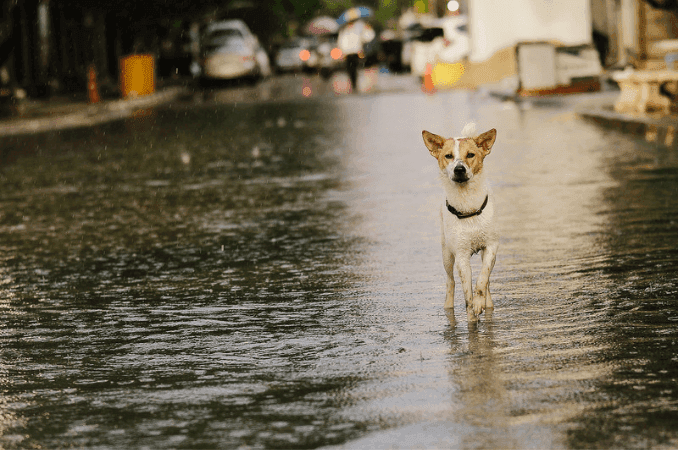
Our Townsville house is in one of the Ross River Dam breach zones. So when the Bureau of Meteorology puts out a cyclone watch, we don’t just think about tape on the windows. We think about where all of us will go if we have to leave. That includes Bindi our Border Collie, our other dog, our cat and 6 chickens.
The first time I really sat down to plan it, I realised the pets were the hardest part. The big kids can pack a backpack. The dogs can’t. Our cat hides under the bed the minute the wind picks up. And you can’t exactly put a flock of chickens in the car boot.
So now we pack a pet kit at the start of every cyclone season, before the first watch goes out. Here is exactly what goes in it, what I found out about where pets can and can’t go in Townsville, and our plan for the chickens.
When is cyclone season in Townsville?
Cyclone season in Queensland runs from November to April. Townsville has been hit hard before. Cyclone Althea in 1971 damaged older buildings, and Cyclone Yasi in 2011 brought destructive winds and coastal flooding.
In January 2024, Cyclone Kirrily crossed near Townsville. Three days later, the council’s Animal Care and Adoption Centre opened so owners could reclaim pets that went missing in the storm.
Then in January 2026, Cyclone Koji headed our way. The council let water out of the Ross River Dam to lower the flood risk, and Townsville was put under a cyclone warning. Koji turned south and crossed the coast between Ayr and Bowen on 11 January. We were lucky. It was a good reminder of why we pack early.
What is the difference between a cyclone watch and a warning?
Knowing this tells you when to act.
- Cyclone watch: gales could reach your area in the next 24 to 48 hours. This is the time to check your pet kit and bring outdoor pets closer to the house.
- Cyclone warning: gales are expected within 24 hours, or have already started. This is the time to move pets inside, put cats in a closed room, and leave early if you are going to leave.
Townsville City Council says to move animals early, because a late evacuation can be very dangerous.
What goes in a pet emergency kit?
Pack one kit for each pet. We use a big plastic tub with a clip on lid for each dog, and a smaller one for the cat.
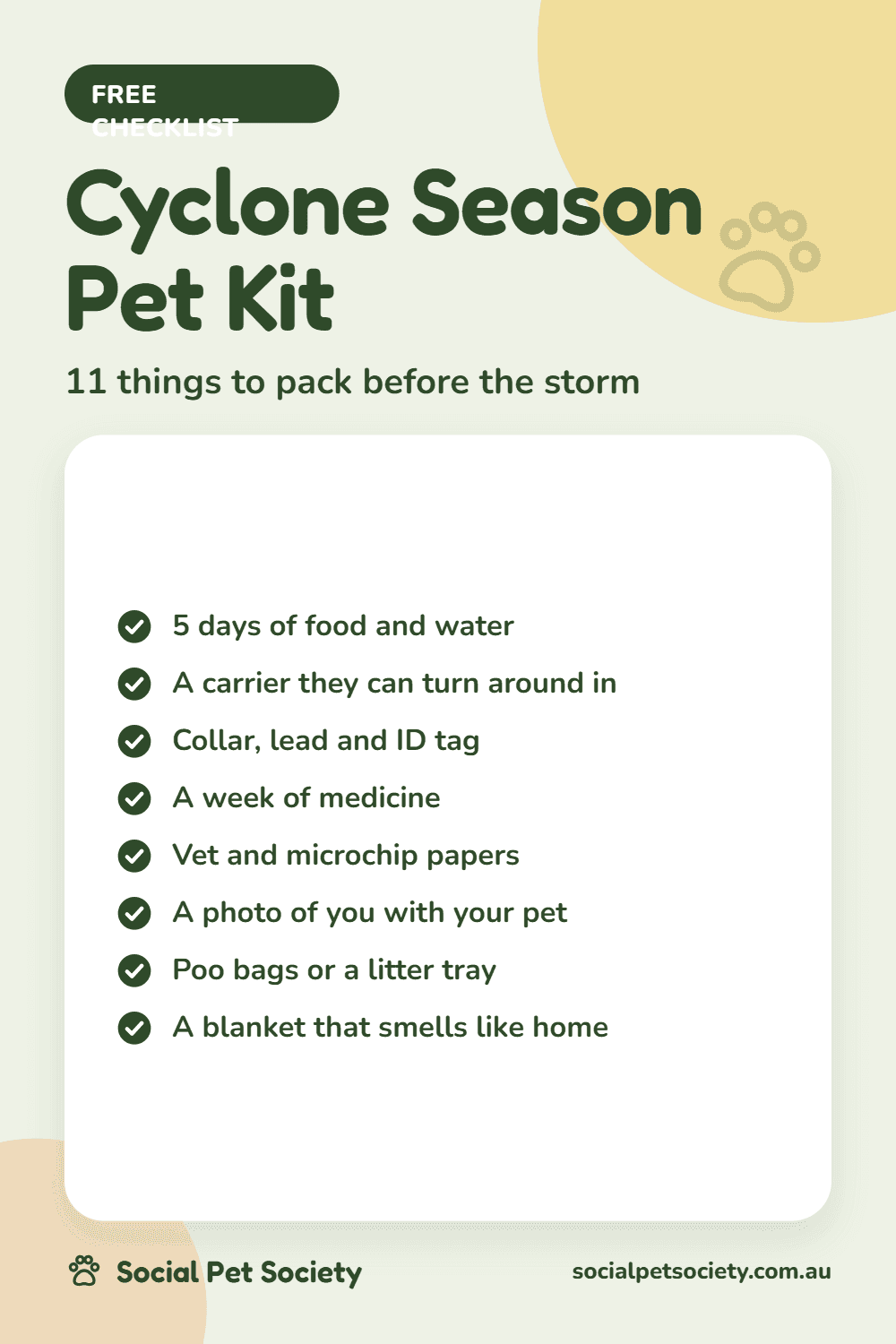
- Food for at least five days. Get Ready Queensland says to pack at least five days of food and bottled water. Their pet plan with the RSPCA suggests a full week, so pack more if you have room. If you use tins, pack a can opener and a spoon.
- Water for at least five days. Keep it separate from the family’s water, so nobody “borrows” it.
- Bowls that won’t tip. Heavy ceramic or wide bottomed bowls are best.
- A strong carrier or crate. It must be big enough for your pet to stand up, turn around and lie down. This is the size Townsville’s evacuation centres asked for in the February 2025 floods.
- Collar, lead and name tag. Put your mobile number on the tag. The council’s Animal Care and Adoption Centre sells engraved phone number tags for $12.30.
- Medicine. The Queensland Government suggests packing up to two weeks’ worth. Add written instructions for anyone who might need to give it.
- Paperwork in a zip lock bag. Vaccination records, the microchip number, council registration, your vet’s phone number and your pet insurance policy number.
- A clear photo of you with your pet. This helps prove they are yours if you get separated.
- Toilet things. Poo bags and gloves for the dogs. A small litter tray and a bag of litter for the cat.
- Old towels and newspaper. Great for wet dogs and messy carriers.
- A small first aid kit. The Animal Welfare League of Queensland says most kits should include bandage rolls, tape and scissors. Ask your vet what else your pet needs.
- Something that smells like home. A blanket or a favourite toy helps a scared pet settle.
Get Ready Queensland and the RSPCA have a free Pet Severe Weather Emergency Plan you can print, fill in and keep in the kit. It walks you through where you will take your pets, who can help if you can’t get home, and the phone numbers you need.
Should I make one kit or two?
The Animal Welfare League of Queensland suggests two kits. One big kit has everything you need to stay home. One small, light kit is ready to grab if you have to leave fast.
In our house, the big “stay” kits live in the laundry. The light “go” kits sit by the back door, right next to the carriers and leads. If we have to leave in a hurry, one adult grabs the dogs and the other grabs the cat and the go bags.
Can I take my pet to a shelter in Townsville?
Sometimes, but not always. This is the part that surprised me most. And I’m not the only one. In a James Cook University survey, 71% of Townsville people were not sure if local shelters allowed pets.
Townsville has three kinds of places to go, and each one has different rules for pets.
- The Public Cyclone Shelter does not take pets. This is the Heatley Cyclone Shelter. Only assistance animals are allowed. The council said this again during Cyclone Koji in January 2026.
- A pet friendly Place of Refuge may open. The council’s disaster group announces it at the time. During Kirrily in 2024 and Koji in 2026, pets could go to the 143 Walker Street Car Park Place of Refuge, with entry from Wills Street. Bring food and water for the whole stay, plus bowls, poo bags or litter.
- Some evacuation centres take pets, and some don’t. In the February 2025 floods, the Heatley Secondary College evacuation centre did not take pets. The Townsville Sports Precinct at 24 Burke Street, North Ward, did take pets in carriers. Evacuation centres supply plain generic pet food, so bring any special food your pet needs.
Wherever you go, these rules apply:
- A lead is not enough. Your pet must be in a sturdy, fully closed cage or carrier.
- Bring a collar and lead, and any medicine.
- Your pet stays your job. Pets are kept out of food preparation, dining and sleeping areas.
The council also says owners must first try to board their pet somewhere suitable, like with friends, family or a boarding kennel. Public shelters are a last resort.
Places change for every storm. Always check the Townsville Disaster Dashboard at disaster.townsville.qld.gov.au, or listen to local radio, before you go.
What if I have to leave my pet at home?
Sometimes leaving pets at home is the only choice. If you must, Get Ready Queensland says to keep them indoors. Put each pet in a separate room with small windows or no windows, like a bathroom or laundry.
- Leave lots of fresh water in large, heavy bowls that can’t tip over. A bath with a little water in it works for dogs.
- Leave extra dry food.
- Never leave a pet tied up outside.
- Put a sign on the front door saying how many pets are inside and where.
What do we do with our chickens?
Six chickens are too many to bring with us, so they need their own plan. Here is what we do.
- Check the coop early in the season. Make sure every panel is secure and nailed down, so nothing can blow loose and hurt the birds.
- Clear the yard. Loose buckets, feed bins and branches near the coop can become flying debris.
- Never let them loose in a storm. Chickens that roam free can be separated from the flock, hurt or killed.
- Bring a small flock inside if you can. For a backyard flock, a large crate in the garage or laundry can work for a night or two.
- Fill extra water. Chickens cannot survive long without water, so we fill extra drinkers before the storm.
- Check for standing water afterwards. Feed and water sitting in floodwater can make the flock sick, so we tip it out and start fresh.
What should I check before the storm comes?
Do these jobs now, while the sky is blue.
- Check your pet’s microchip details. Is your phone number still right? Get Ready Queensland says to microchip and register every pet.
- Check your council registration. Townsville changed its registration year in 2026. It now runs from 1 July to 30 June, so renew by 30 June each year.
- Pick a pet buddy. This is a friend or neighbour who can grab your pets if you can’t get home. Show them where the kits are.
- Ring a boarding kennel now. Ask if they take pets during storm warnings and how much notice they need.
- Practise with the carrier. Leave it out with a blanket and treats inside. A cat that has never seen a carrier will not get in one during a storm.
What if my pet goes missing after a cyclone?
Call Townsville City Council’s Animal Care and Adoption Centre on 0457 769 362. It is on Tompkins Road in Shaw, and this is where lost animals are taken. If your dog is registered or your cat is approved, the first release in 12 months is free. An unregistered pet costs $132.50 to $220.50 to get back.
Share your clear photo on local lost pet pages too. And keep checking for days, not hours. After Kirrily, the centre was still reuniting families once the storm had passed.
Our final tip
Pack your kit before the first cyclone watch, not during it. It took us about an hour for everyone, chickens included. That hour could save a life.
Once the storm has passed and the dogs need a good run, check out our list of off leash dog parks in Townsville at socialpetsociety.com.au/townsville.
Looking for pet friendly places to stay or a vet near you? Search the Social Pet Society directory.
Frequently asked questions
Are pets allowed at the Heatley Cyclone Shelter?
No. Only assistance animals are allowed at Townsville’s Public Cyclone Shelter.
Where can I take my dog during a cyclone in Townsville?
Try friends, family or a boarding kennel first. If you can’t, the council will name a pet friendly Place of Refuge on the Disaster Dashboard. In 2024 and 2026 it was the 143 Walker Street Car Park.
How much food should go in a pet emergency kit?
At least five days, says Get Ready Queensland. A full week is even better.
Is it free to get my lost pet back?
Yes, the first time in 12 months, if your dog is registered or your cat is approved.
What should I do if my pet goes missing after a storm?
Call the Townsville Animal Care and Adoption Centre on 07 4727 8371 or 0457 769 362.
This article is for general information only and isn’t a substitute for professional advice. The sources we used are listed below.
References
- Animal Welfare League Queensland (2022) Preparing your pets in case of disaster. Available at: https://reference.awlqld.com.au/wp-content/uploads/2022/10/2022_AWLQ_SafetyTipsForPets_DL_FINAL.pdf
- Australian Institute for Disaster Resilience (2021) Promoting owner responsibility for pets in disasters. Australian Journal of Emergency Management, July 2021. Available at: https://knowledge.aidr.org.au/resources/ajem-july-2021-promoting-owner-responsibility-for-pets-in-disasters/
- Bureau of Meteorology (n.d.) Tropical cyclones: what you need to know. Available at: https://www.bom.gov.au/news-and-media/tropical-cyclones-what-you-need-to-know
- Bureau of Meteorology (2026) Tropical Cyclone Koji, 7 to 14 January 2026. Available at: https://www.bom.gov.au/cyclone/history/Koji_2026.shtml
- Get Ready Queensland (n.d.) Protect your pet. Available at: https://www.getready.qld.gov.au/pets
- Get Ready Queensland and RSPCA Queensland (2023) Pet Severe Weather Emergency Plan. Available at: https://getready.qld.gov.au/sites/default/files/2023-11/0845%20GRQ-RSPCA%20Pet%20Severe%20Weather%20Emergency%20Plan.PDF
- Queensland Government (n.d.) Pet emergency plan. Available at: https://www.qld.gov.au/emergency/dealing-disasters/prepare-for-disasters/prepare-pets
- Townsville City Council (n.d.) Animals in disaster. Available at: https://townsville.qld.gov.au/community-support/pets-and-animals/animals-in-disaster
- Townsville City Council (n.d.) Animal registrations. Available at: https://www.townsville.qld.gov.au/animal-registrations
- Townsville City Council (2024) Prepare to shelter from Cyclone Kirrily now, 25 January. Available at: https://www.townsville.qld.gov.au/about-council/news-and-publications/media-releases/2024/january/prepare-to-shelter-from-cyclone-kirrily-now
- Townsville City Council (2024) Services begin reopening in Townsville, pets available to reclaim, 28 January. Available at: https://www.townsville.qld.gov.au/about-council/news-and-publications/media-releases/2024/january/services-begin-reopening-in-townsville,-pets-available-to-reclaim
- Townsville City Council (2025) Black zone must evacuate by 12 noon Sunday 2 February, 1 February. Available at: https://www.townsville.qld.gov.au/about-council/news-and-publications/media-releases/2025/february/black-zone-must-evacuate-by-12-noon-sunday-2-february
- Townsville City Council (2026) Residents prepare to shelter in place, 10 January. Available at: https://www.townsville.qld.gov.au/about-council/news-and-publications/media-releases/2026/january/residents-prepare-to-shelter-in-place
- Townsville City Council (2026) Fees and charges 2026–27: animal management. Available at: https://www.townsville.qld.gov.au/__data/assets/pdf_file/0023/327623/fees-and-charges-2026-27_animal-management.pdf
- Wikipedia (2026) Cyclone Koji (2026). Available at: https://en.wikipedia.org/wiki/Cyclone_Koji_(2026)
Related articles
Health and Wellbeing
Cane toads and dogs, signs of poisoning and what to do
Cane toads can poison a dog in minutes. Learn the signs of cane toad poisoning, the wipe, rinse and ring first aid steps, and how we keep toads out of our Townsville backyard.
· Talitha Mulder
Health and Wellbeing
How to Make Walking the Dog Part of Your Daily Routine (the Atomic Habits Way)
Struggling to walk the dog every day? Here’s how I used the four rules from Atomic Habits to turn our dog walk into a habit that sticks, plus a fill-in plan you can print and put on the fridge.
· Talitha Mulder
Health and Wellbeing
Is Having a Pet Good for Kids? What the Research Says
Is having a pet good for kids? From responsibility and empathy to comfort for only children, here’s what research says about kids and pets, the best age to get one, and how to keep babies and young children safe around animals.
· Talitha Mulder
Health and Wellbeing
How to Build a Stronger Bond With Your Dog (What the Research Says)
Want a closer bond with your dog? Learn what science says about the dog and human bond, the signs your dog is attached to you, how long bonding takes, and four simple ways to strengthen your connection through touch, play, routine and a calm home.
· Talitha Mulder
Health and Wellbeing
Is My Cat Happy? Use This Checklist to Tell if Your Cat is Content
Not sure if your cat is happy? Use this simple checklist to read the signs of a content cat, spot the warning signs of stress or illness, and learn easy ways to set up your home and routine so your cat feels safe, busy and loved.
· Talitha Mulder