
How To Register Your Pet in Townsville
In 2024, Townsville had 28,491 registered dogs and 4,192 registered cats. If you have a pet and you’re wondering about the rules for registering them in Townsville, I’ve gathered all the necessary information in one convenient article below. To register your pet in Townsville, visit the Townsville…

In 2024, Townsville had 28,491 registered dogs and 4,192 registered cats. If you have a pet and you’re wondering about the rules for registering them in Townsville, I’ve gathered all the necessary information in one convenient article below.
To register your pet in Townsville, visit the Townsville City Council’s Animal Registration Payments page here. All cats and dogs must be registered annually, wear a registration tag, and be microchipped before 12 weeks of age, otherwise you risk being fined.
Table of Contents
Disclosure: This article includes affiliate links. If you click on these links and make a purchase, I receive a small commission. This comes at no extra cost to you but greatly supports the maintenance of this site. Learn more here.
General Owner Responsibilities
Owning a pet can be a rewarding experience, but it comes with responsibilities. Pets, like dogs and cats, are valued members of our community, offering companionship and security.
If you own a pet in Townsville, you are legally responsible for them at all times. Specifically, your responsibilities are:
Registration
All dogs must be registered, and all cats require permits.
Microchipping
It’s mandatory for all dogs and cats to be microchipped before they reach 12 weeks of age. Contact your local vet clinic to arrange microchipping for your pet. Sometimes, the Council may offer free microchipping at events for registered dogs and approved cats in Townsville. Keep an eye on What’s On Townsville for more information about these events.
Desexing
Desexing your pet has many benefits, including improving their health, reducing behavioural issues like roaming, preventing unwanted litters, and potentially increasing their lifespan. Desexed pets also cost less to register.
Effective Control
When in public places, your dog (or cat) must be under effective control, such as being on a leash. It’s the responsibility of you to ensure they are not aggressive towards people or other animals.
Adequate Enclosure
You must provide a suitable enclosure for your dog or cat to prevent them from escaping the yard or roaming freely.
Health & Exercise
It’s important for you to exercise your pets and clean up after them in public spaces. This helps maintain their health and keeps public areas clean and safe for everyone.
Why Does the Council want my Pet Registered?
Keeping track of your pets in the city is crucial for your peace of mind and helps the Council plan for the community’s future needs. Here in Townsville, it’s a must to register your dog every year and make sure they wear their registration tag. Cats need approval too, which needs to be renewed annually.
The Townsville City Council has specific rules, known as local laws, about how pets and other animals should be looked after. These rules set the minimum standards and outline what approvals you need to keep different types of animals.
Council officers make sure everyone follows these rules. They also keep an eye on things like registration, microchipping, and specific rules for certain types of dogs. Councils also have to follow the National Animal Management (Cats and Dogs) Act 2008.
Registration Costs
All of the below fees are based on a 12 month period.
Dog Registration Fees
Full fee period:
Entire dog $136.80
Desexed dog $51.30
Approved Pensioners:
Entire dog $34.20
Desexed and microchipped (first dog) No charge
Desexed and microchipped (each subsequent dog) $17.10
Other:
Dangerous dog $684.00
Menacing dog $684.00
Replacement tag No charge
Replacement distinctive collar fee $89.50
New dangerous dog signs (replacement upon request) $89.50
Animal Keeping Permits
Cat Approval:
Standard $18.10
Approved Pensioner No charge
(conditional on the cat being desexed and microchipped)
Additional Dogs or Cats on Premises:
$212.00 for 3-4 Dogs/Cats
(valid for 3 years)
Kennel or Cattery Approval:
$212.00 for Kennel (5+ dogs) or Cattery (7+ cats)
(valid for 3 years)
Bird Permit:
$212.00 for Cockatoo, galah, peahen, or peacock on an allotment less than 4,000sqm
(valid for 3 years)
Release from Animal Shelter
First release:
Registered dog or approved cat: No charge
Unregistered dog or non-approved cat: $190.50 (entire) / $114.50 (desexed)
Second and subsequent release:
Dog or cat: $281.00
Daily Sustenance Fee: $16.50 per animal per day
Rescue Fees (Stock)
These fees are a bit more complicated and involve fees for feed, vet or other charges, impounding and transport, and administration fees, which are charged based on recovery of service providers’ costs to council plus 5%.
Dog Registration Rules
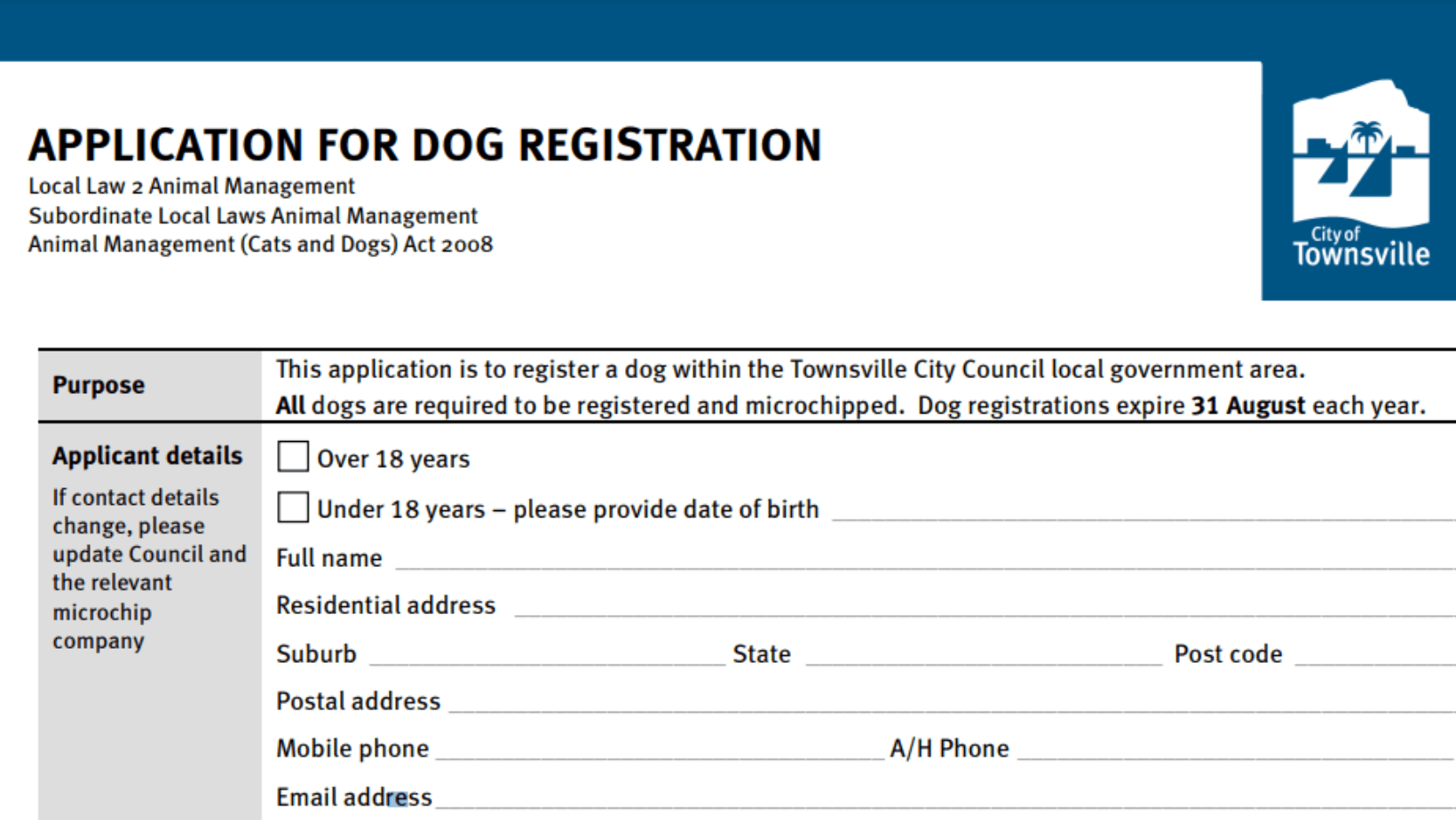
Under the Animal Management (Cats and Dogs) Act 2008, all dogs must be registered.
Registration renewals are sent out in August each year and must be renewed by August 31st annually.
For new registrations, renewals, reciprocal registrations, or updating your dog’s details, you can visit the Council’s Animal Registration Payments page here.
The Rules are:
- All dogs, including puppies, must be registered within 14 days of getting them or moving to Townsville.
- If any information on the registration notice changes, you have 7 days to inform the Townsville City Council.
- Your dog must wear the registration tag at all times.
- It’s a legal requirement for your animal to have a microchip implanted, as per the Animal Management (Cats and Dogs) Act 2008.
- Certain breeds like the American Pit Bull Terrier, Dogo Argentino, Fila Brasilerio, Japanese Tosa, or Perro de Presa Canario are restricted and prohibited by the Townsville City Council.
- You must have an adequate enclosure to prevent your animal from escaping. Failure to do so could lead to action being taken.
- When walking your dog, they must be on a lead or tether and under control by a person who can manage them physically.
- You’ll receive a lifetime tag, but replacements are only given upon request (with conditions).
- Keeping dogs on a lead or tether isn’t enough.
You need to understand and comply with all the requirements and conditions set out by the Townsville City Council’s Local Laws.
How Many Dogs Can I Have?
The number of dogs you’re allowed to have depends on the size of your property:
- If your property is under 400 square meters, you need a Deemed Approval, and you’re allowed the number specified in the document.
- For properties that are at least 400 square meters but less than 4,000 square meters, you’re allowed a maximum of 2 dogs (or 4 with Approval).
- Properties that are 4,000 square meters or larger can have a maximum of 4 dogs.
- If you have a kennel on your property that is at least 400 square meters, you can have 5 or more dogs with Kennel Approval.
- Multi-residential premises such as flats, boarding houses, tenement buildings, home units, townhouses, and duplexes have specific regulations, so it’s best to refer to the relevant documentation for guidance.
Cat Registration Rules
Cats have very similar rules to dogs. However cats need to be approved not registered (although, this is a very similar concept)
- The approval expires on August 31st each year.
- You’re allowed to keep up to two cats within the Townsville City Council area with this approval.
- You must take all reasonable steps to prevent your cat(s) from causing a nuisance or disturbance to others.
- Any enclosure where the cat(s) are kept must be kept clean, disinfected regularly, and in good condition.
- This approval is valid only for the person at the stated address.
- Your cat(s) must be kept according to the minimum standards for their species outlined in Schedule 5 of Subordinate Local Law No. 2 (Animal Management) 2011.
- Failure to comply with these conditions may lead to the withdrawal of the approval.
- The enclosure must be properly drained, and runoff should not enter neighbouring land.
- Any waste that may become offensive must be collected daily and disposed of properly in a council-approved waste container.
- You must inform the council if you change your address or no longer need the approval.
Microchips:
All cats obtained, purchased, or acquired are required by law to be microchipped. Kittens must be microchipped before they reach 12 weeks of age.
How Many Cats Can I Have?
The number of cats you’re allowed to have depends on the size of your property:
- For properties under 400 square meters, or in multi-residential premises like flats, boarding houses, tenement buildings, home units, townhouses, and duplexes, you can have a maximum of 2 cats with approval.
- If your property is at least 400 square meters but less than 4,000 square meters, you can have 3 to 6 cats with approval.
- Properties that are 4,000 square meters or larger allow up to 6 cats with approval.
- If you have a cattery on your property that is at least 400 square meters, you can have 7 or more cats with Cattery Approval.

The National Law
Keeping Animals
The local government or council has rules and powers about how you need to manage your animals.
They might say you can’t have certain animals, or you need permission first. Sometimes they require animals like cats or dogs to be spayed or neutered, unless there’s a good reason not to. If a pet is supposed to be fixed but isn’t, that’s against the law.
The government can also set rules for how animals should be treated and make sure people follow them. For example, if your cat or dog isn’t at home, they might need to wear tags with their name and your address.
Control of Animals
This part of the rules deals with animals in public places. It says where animals can and can’t go, like parks or certain areas.
If there are places where dogs can be off-leash, the government will say so, but owners have to follow the rules there. When pets are in public, they need to stay under control, and owners have to clean up after them if they make a mess.
Owners also have to make sure their pets can’t get loose from their yards. If there are concerns about wildlife in particular, there might be special rules for keeping dogs. The rules also talk about making sure animals don’t scare or hurt anyone. If an animal is considered dangerous, there are rules for that too, to keep everyone safe.
Found Animals
Local governments and councils can seize animals if they’re wandering around alone, haven’t followed rules, attacked someone, or seem abandoned. If an animal is dangerous or suffering a lot, they might have to put it down right away.
The seized animals might be returned if the conditions are right. Owners will get notices about what’s happening with their pets. If an animal keeps causing problems, the authorities might decide it needs to be put down. Owners can argue against this decision, though.
If no one claims a pet, it might be sold, given away to a local adoption agency (like angel paws), or put down. The money from any sales goes towards costs. There are rules about keeping records of seized animals, and owners can check on their pets without paying.
It’s actually against the law to take back a pet without permission, and the owners will have to pay any costs involved.
Conclusion
What are your thoughts on the regulations mentioned? Do you believe they strike the right balance between ensuring responsible ownership and respecting pet owners’ rights? Let me know in the comments below!
Talitha Mulder
Certificate II in Animal Studies | Bachelor of Nursing Science
- Townsville City Council. (2018, November 19). Townsville City Council Animal Registrations [Data set]. data.gov.au. https://data.gov.au/dataset/ds-dga-6d43565d-51a9-4e66-aef4-6bdb7b2abb9d
Related articles
How-To Guides
How to Teach Your Dog a Praise Word (Marker Word) in 4 Easy Steps
A praise word like “YES!” tells your dog the exact moment they got it right. Here’s how to teach one in 4 easy steps, the gear you need, the mistakes to avoid and what happened when our Border Collie Bindi learnt hers in week one of obedience training.
· Talitha Mulder

How-To Guides
How to Start a Pet Sitting Business in Australia: 9 Steps to Real, Consistent Income
Want to start a pet sitting business in Australia? This step by step guide covers choosing your niche, setting up your ABN and insurance, pricing your services, finding your first clients and building a business that earns consistent income, with lessons from running a real service business.
· Talitha Mulder
Pet-Friendly Hotels Ayr QLD – 2025 Verified Guide
Looking for pet-friendly hotels in Ayr QLD? Check our 2025 guide with verified pet policies, hotel contacts, and tips for staying with your dog.
· Talitha Mulder