
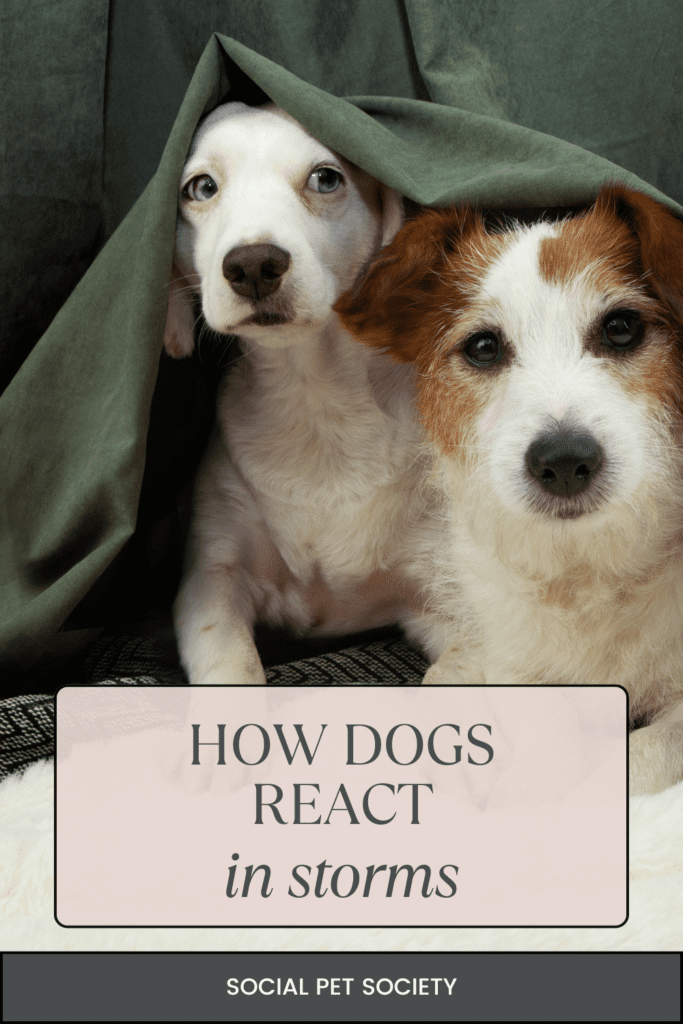

When the thunder rolls, my Border Collie whinges, pacing and panting inside – but why?
Is it the unknown?
The volume?
The sound?
The dark?
Or is it how we change around them – anxiety in the air, tension rising with every flash?
Dogs don’t fear storms the way we do. It’s something else. Something instinctual.
But what makes it so overwhelming for some?
Table of Contents
Disclosure: This article includes affiliate links. If you click on these links and make a purchase, I receive a small commission. This comes at no extra cost to you but greatly supports the maintenance of this site. Learn more here.
Here are the facts:
Fear of thunder in dogs is common
About 43.6% of dogs show signs of anxiety during storms.
Fear can become severe
It can shortening the dog’s lifespan and causing major distress for the owner.
The risk factors
- Vocalisation is a unique symptom, not tied to other signs of fear.
- Younger dogs are less likely to fear thunder, while fear increased with age—until the elderly, where it seemed to decrease.
- Miniature Dachshunds and Toy Poodles show less fear compared to other breeds.
- Dogs in houses are more likely to fear thunder than those in apartments.
- When owners are afraid of storms, their dogs are more likely to be fearful too.
- Fear of thunder doesn’t correlate with regional storm frequency or the dog’s socialisation period.
Methods to Help Dogs During Thunderstorms
Create Their Safe Place
When the storm rages outside, our dogs need to feel like they have somewhere safe, somewhere they can truly relax. It doesn’t have to be fancy—just a quiet corner, a cozy crate, or even a blanket fort. It’s not about hiding from the storm, but giving them the space to feel grounded. A place where the noise is muffled, and they can retreat when the world feels too loud.
Gradual Exposure to the Storm
You can’t rush comfort. The more you expose your dog to the sound of thunder, the more it can lose its power over them. But start small. Play a recording of thunder softly while they’re engaged in something positive—maybe a treat, a toy, or simply time together. Let them adjust at their own pace, building the connection between the sound and safety, so that with time, the storm isn’t so frightening anymore.
The Power of Touch: ThunderShirts
Compression is more than just a soothing sensation—it’s a deep, comforting hug. ThunderShirts and calming jackets work by gently wrapping your dog in a way that eases anxiety. It’s not about hiding from the storm but helping them find their centre amidst the chaos. It’s that feeling of someone being there, even when you’re not looking directly at them.
Music that Mutes the Storm
Sound is a storm’s weapon. And the right kind of sound can soften its bite. Play calming music or white noise that drowns out the thunder. It’s like a gentle, constant companion, one that reassures them without overwhelming. The sound of soft music can be their anchor, a soothing presence that lulls them into calmness.
Pheromone Diffusers: An Invisible Calm
There’s something incredibly powerful in scents that can bring peace. Pheromone diffusers like Adaptil don’t just mask the storm—they help to speak to their senses in a way words can’t. They trigger a calm within, a familiarity that reassures them in a language beyond sound. It’s a subtle act of care, invisible but deeply felt.
Teaching Calmness, Not Fear
It’s not enough to expect calm—it has to be nurtured. In the midst of a storm, praise and reward your dog when they show signs of calmness, even if it’s just a small moment. Over time, this positive reinforcement teaches them that peace is more valuable than panic. You’re not just helping them through the storm—you’re teaching them to find their own strength within it.
When the Storm is Too Much: Veterinary Help
Sometimes, a dog’s fear is more than just fear—it’s a burden they can’t bear alone. If their anxiety becomes overwhelming, don’t hesitate to consult a vet. It’s not about labelling them as weak, but recognizing when they need extra help. Medication or natural calming supplements can offer them a little peace, a reminder that they don’t have to fight this alone.
Your Calm is Their Calm
Your dog watches you more closely than you know. They sense when you’re anxious, and they mirror it. If you stay steady, your dog feels steadier. It’s not about pretending the storm isn’t happening but showing them through your actions that there’s no need to panic. They look to you for reassurance, and your calm presence is one of the most powerful tools you have.
No Place for Punishment
Fear is real, and it’s not a behaviour they can control. Punishment will only add to their confusion and stress. Instead, offer them comfort in ways that affirm their feelings. You’re not just a caretaker in moments of fear—you’re a safe harbour that doesn’t judge them for their instincts, but helps them through the storm with patience and understanding.
Exercise: A Tired Mind is a Calmer Mind
A dog that’s been exercised, mentally and physically, is a dog that’s better able to cope with stress. Before a storm, take them for a walk, run, or engage them in a game. The physical release is calming, and the mental engagement distracts from the approaching anxiety. When the storm hits, they’ll be less likely to react out of nervous energy and more likely to seek calm. The storm may never stop, but that doesn’t mean our dogs need to face it alone.
Conclusion
So, it’s not just the thunder.
It’s the owner’s reactions, the environment, the age, and maybe even the breed.
There’s more we can do to help dogs—understanding their fear and addressing it.
The methods can create an environment where your dog doesn’t just survive the thunder—they learn to cope with it, to feel protected, and to trust that no matter what happens outside, they are safe.
References
Okamoto, K., Inoue, K., Kawai, J., Yamauchi, H., Hisamoto, S., Nishisue, K., Koyama, S., Satoh, T., Tsushima, M., & Irimajiri, M. (2024). Factors influencing the development of canine fear of thunder. Applied Animal Behaviour Science, 270, 106139. https://doi.org/10.1016/j.applanim.2023.106139

